
by Timothy McQuiston, Vermont Business Magazine
Windham County: Growth, despite headwinds
Submitted by tim on
by Timothy McQuiston, Vermont Business Magazine
Windham County and the broader southern Vermont region face many of the same structural headwinds as the rest of the state: housing shortages, workforce gaps and increasing demands on the tax base. Recent tariff pressures and global trade concerns are bringing new and very real threats to Vermont businesses that are inextricably linked to the global economy.
But economic development leader Adam Grinold, executive director of the Brattleboro Development Credit Corp., said he sees these challenges as opportunities to strengthen the regional economy through increased regional partnerships, targeted investments, long-term planning efforts and cross-sector collaborations. There also is a welcoming of New Americans. And for the region’s vital tourism industry, a jolly good winter.
“A very low common denominator that I observe is successful businesses have figured out how to attract and retain their talent,“ Grinold said. “Other successful businesses have buyers from outside of our economy, so they may be doing value-add to a product here, but selling it afar.
“Any healthy economy is where you export goods and you import capital. That capital gets sloshed around in the local economy and creates new wealth and higher wages.“
There are also significant local efforts to expand the economy through collaboration and investment. These include business expansion at WheelPad in Wilmington, housing development at the Chalet in West Brattleboro and cross-county efforts among Young Professionals and business organizations, notably through the upcoming Southern Vermont Economy Summit in May.
Grinold provided a long list of processes, successes and issues.
Housing, he said, is the foundation of economic growth “and it’s one of the most urgent issues we hear about — from manufacturers to hospitals to schools. Employers can’t recruit or retain staff if workers can’t find a place to live. That’s why BDCC has partnered with local employers and housing developers, and even worked on specific first-time homebuyer programs with organizations like Windham & Windsor Housing, to tackle both affordability and availability.“
A report prepared by the Vermont Housing Finance Agency, titled “2025-2029 Vermont Housing Needs Assessment,“ calculated a housing deficit of between 1,461 and 2,275 units in Windham County and between 985 and 1,588 units in Bennington County. There are 51,146 units now. The current population is estimated at 87,546 in southern Vermont (average age 47.8) and a state total of 667,641 (average age 43.7; U.S. 39.3).
“Workforce and demographics are closely tied. Vermont’s aging population means the labor force is shrinking just as demand for skilled workers is rising,“ Grinold said. “That’s why BDCC’s Pipelines and Pathways Program connects high school students with local career opportunities. It’s also why we launched the Welcoming Workplaces initiative — to help employers better attract, onboard and retain new talent, including newcomers to the region. The Expand Your Talent options found here help employers learn effective strategies.“
Southern Vermont has the lowest proportion of high-income households, defined as those earning over $200,000, in the state. Its median household income is $67,529, compared to the Vermont average of $77,065 and the U.S. average of $79,068.
To address these disparities, the BDCC is participating in Think Vermont’s GROW program (Grants for Relocation Outreach Work), a funding initiative designed to support relocation, recruitment and retention efforts in the state. The program is funded by the Legislature as part of the Department of Tourism and Marketing’s annual budget.
The GROW program provides one-on-one support to workers who are looking to move to the state, along with events and programs for newcomers through the Vermont Welcome Wagon. Relocation resources can be found at BDCC’s SoVermont website (sovermont.com).
“Supply chains and tariffs are more than global issues,“ Grinold said, “They have local consequences. Our region has several employers who rely on imports, and rising costs can be destabilizing. That’s part of why BDCC has been exploring the potential for a foreign trade zone in southern Vermont, which would help manufacturers defer or reduce duties on imported goods, making local production more cost-effective and competitive. We are also standing up a program to help businesses better model their financial planning, taking into consideration shifting costs of goods.“
Chris Campany, executive director at the Windham Regional Commission, noted that there continues to be investment in the region, citing examples such as the town of Rockingham’s redevelopment of the Bellows Falls train station, the conversion of the M&T Bank space in Brattleboro into the Snow Republic Brewery, the reopening of the Four Columns Inn and the Newfane Inn in Newfane, and the upcoming opening of the River & Rye restaurant in Jamaica.
“My priority for the next 10 years or so will be using the Act 181 reforms to regional planning and future land-use mapping to work with towns to explore in greater depth and detail not only how they want to grow, but also how to grow up and away from flood hazards and mitigate other climate risks such as drought, heat and wildfire.
“In my experience,“ he added, “this means going beyond town plan policy, and supporting physical master planning, capital planning and capital finance planning and strategy that gets into the detail of what development is best suited where, and what physical infrastructure is needed to support it.
Land conservation is the other side of the development coin, Campany noted. With the increasing frequency of flooding, drought, and wildland fire risk, conservation of natural areas is essential to buffer these events and is the most cost-effective way to ensure southeast Vermont remains a safe place to live and work.
This spring, Campany said, the Windham Regional Commission is coordinating a four-town flood adaptation rapid conceptual design and scenario planning project with Dover, Wilmington, Whitingham and Readsboro in the Deerfield Valley, in collaboration with the Landscape Architecture and Regional Planning Graduate Program at UMass-Amherst and the Architects Foundation’s Communities by Design program.
“This builds off of lessons learned from the four-town housing planning project we did last year in the northwestern corner of our region,“ Campany said. “The idea is to bring towns together to explore challenges that they have in common, visualize design solutions and how they might sit on the landscape, and provide a report on land suitability and development scenarios that they can use in their own planning going forward.“
A Boost to Brattleboro
Brattleboro is making significant strides with innovative initiatives aimed at addressing its critical housing shortage and providing more affordable options for its residents.
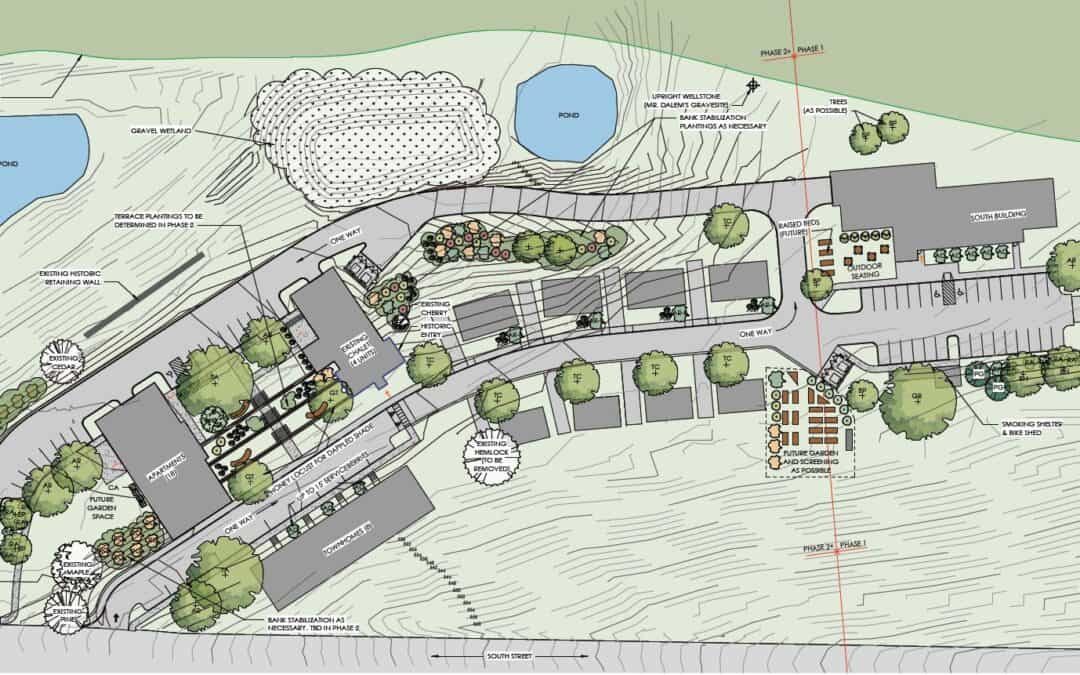
The Windham & Windsor Housing Trust and its co-developer, Evernorth, have laid the groundwork to redevelop the historic Dalem’s Chalet property in West Brattleboro, which the trust had acquired in 2020 to provide emergency housing during the COVID pandemic.
The planned redevelopment will preserve the original Chalet building and create a new neighborhood with a mix of housing types and architectural features. The conceptual design was informed by residents currently living at the Chalet and in the immediate neighborhood, along with municipal staff and staff at Groundworks Collaborative, WWHT’s service partner.
This first phase of the multiphase project will provide 31 new apartments, 24 of which will target low-income households. Fifteen of these apartments will serve as permanent supportive housing units, offering a stable environment for individuals and families exiting homelessness. Additionally, Groundworks will provide voluntary, comprehensive, on-site services in the building for all residents.
The project’s funding drive began in February with a $6.2 million award from the Vermont Housing and Conservation Board. This was followed in late April by the Vermont Housing Finance Agency Board of Commissioners approving federal low-income housing tax credits, part of a broader initiative to fund approximately 128 new affordable homes across the state.
The funding comes at a critical time for Vermont as the state works to expand affordable housing options, particularly for low-income families, older adults and households who have experienced homelessness.
“We are grateful for the board’s support and commitment to the development of more affordable housing here in southeastern Vermont,“ said Elizabeth Bridgewater, executive director of the housing trust. “This funding allows us to continue moving forward with our vision of transforming the Chalet property into a vibrant, sustainable neighborhood with affordability for households earning a range of incomes, and new housing opportunities for our community while taking a meaningful step in reducing Brattleboro’s dire housing shortage.“
The project design includes single-family homes for homeownership, townhouses for rental opportunities, new multifamily rental buildings and a community space in the iconic Chalet building, which will be renovated with many of its historic features remaining intact.
Fifteen homes will be designated as permanent supportive housing. The construction of 70 homes in total will move forward in four phases, beginning in late 2025.
Once completed, the Chalet property is expected to contribute over $100,000 annually in taxes to the town of Brattleboro.
