
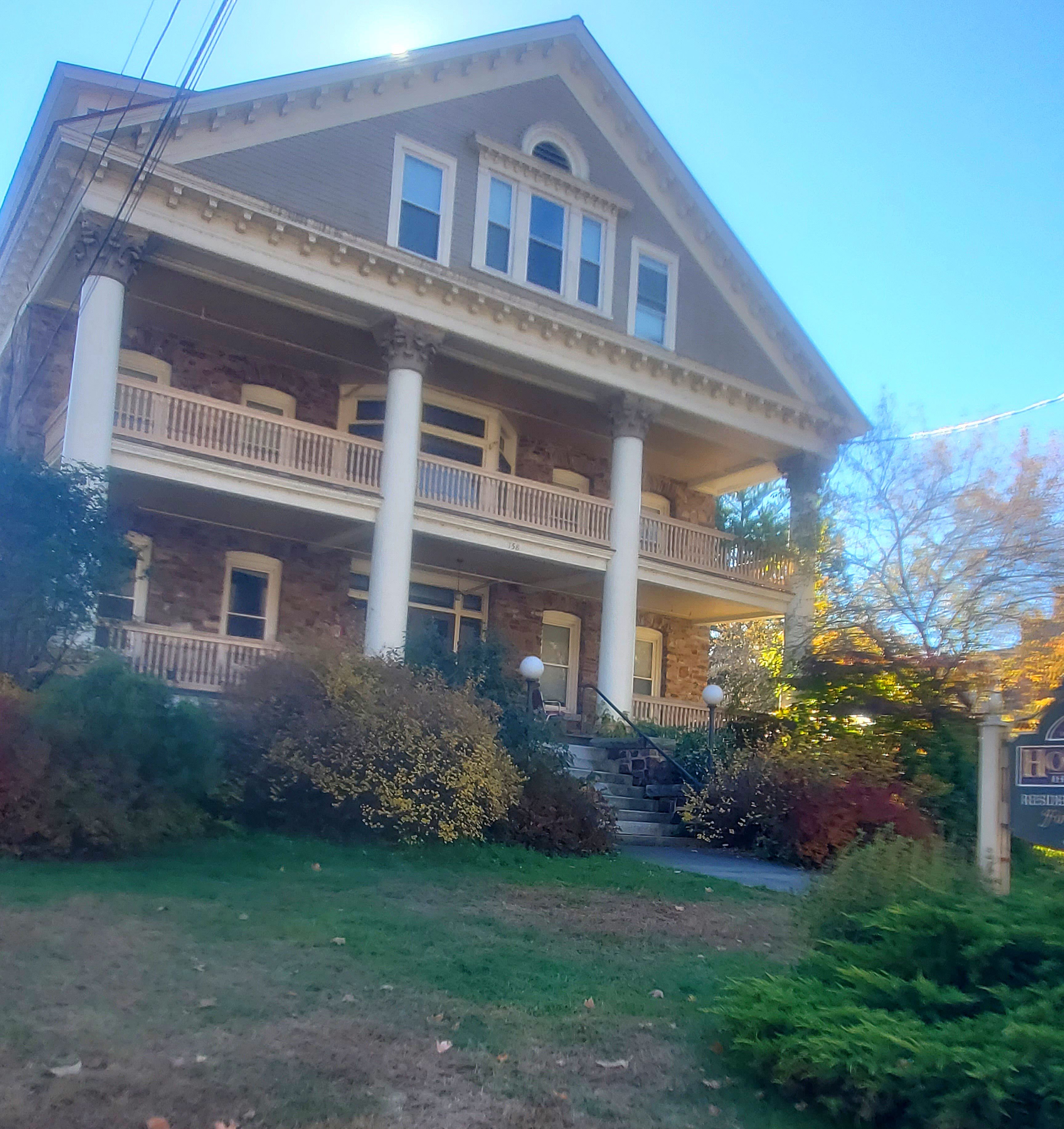
Holton Home
Holton Home
Permitting, Funding
Number of homes: 21 apartments
Architect: Stevens & Associates
General Contractor: HP Cummings Construction
This historic rehabilitation will focus mainly on the interior of the building converting the 35 single room style into 21 apartments (studio, one- , two-, and three-bedroom apartments). Up to 5 will be set aside for individuals with intellectual and developmental delays with their in-home support.
Rents will be set to target the income eligibility thresholds that range from low- to moderate- workforce and fixed income levels based on Windham County incomes.
Scroll down for FAQ list.
Project Updates:
This section of the website will be updated with project status updates. During feasibility, permitting and funding phases there will be likely fewer updates as the project moves through the process. Once construction starts, updates will be more frequent. Thanks for staying up to date!
May 2026: DRB hearing
Holton Home redevelopment was presented to the Brattleboro Design Review Board in May where the board approved the site plans. Find the news coverage here >>
Fall 2025 Update: Funding
WWHT recently received $800,000 through HOME, $1m through National Housing Trust Fund, and $2.6 million of funding from the Vermont Housing and Conservation Board to advance Holton Homes which includes up to five of the apartments that will be set aside for individuals living with developmental disabilities, through a collaboration with Black Mountain Assisted Family Living. For these residents, the project will offer not just a home, but supported space with shared living providers within a neighborhood that’s walkable, welcoming, and connected.
Creating homes like this has been named a state priority under Act 186. Passed in 2022, the law supports the creation of new housing models for people with intellectual and developmental disabilities, emphasizing community-based, person-centered living options.
Jenny Hyslop, Housing Director with VHCB has been engaged in the statewide work around this gap in housing, “In our work with individuals with developmental disabilities and their families, we know that there is an unmet need for as many as 600 homes around the state to house this population. Many individuals live with parents who are aging and are deeply concerned about what comes next for their adult sons and daughters. WWHT’s re-envisioning of Holton Homes creates an opportunity for individuals to live within a vibrant community, with access to appropriate services, in a setting that is dignified and supports autonomy.”
Background
A New Phase for Holton Home
In the heart of Brattleboro, the historic Holton Home has stood for more than a century as a place of care. Chartered in 1892, it served generations of older Vermonters as an assisted living home. Now, Windham & Windsor Housing Trust is shepherding this beautiful, historic building into a new phase: adaptively repurposing the building into 21 permanently affordable apartments. The redevelopment focuses on the interior of the building, shifting the current layout of 36 bedrooms into two studios, seven one-bedrooms, eleven two-bedrooms, and one three-bedroom apartment – offering a range of housing options for different family sizes and needs while preserving the exterior.
What makes the project especially meaningful is that up to five of these apartments will be set aside for individuals living with developmental disabilities, through a collaboration with Black Mountain Assisted Family Living. For these residents, the project will offer not just a home, but supported space with shared living providers within a neighborhood that’s walkable, welcoming, and connected.
WWHT recently received funding from the Vermont Housing and Conservation Board to advance the project, which has been named a state priority under Act 186. Passed in 2022, the law supports the creation of new housing models for people with intellectual and developmental disabilities, emphasizing community-based, person-centered living options.
Jenny Hyslop, Housing Director with VHCB has been engaged in the statewide work around this gap in housing, “In our work with individuals with developmental disabilities and their families, we know that there is an unmet need for as many as 600 homes around the state to house this population. Many individuals live with parents who are aging and are deeply concerned about what comes next for their adult sons and daughters. WWHT’s re-envisioning of Holton Homes creates an opportunity for individuals to live within a vibrant community, with access to appropriate services, in a setting that is dignified and supports autonomy.”
For families, especially aging parents of adults with disabilities, this project offers a deep sense of relief from knowing that their children will have a long term, safe and supported home into the future.
“Our sole mission is to provide permanent housing for people with developmental delays at an affordable rate.” Shares Peter Case, board President of Black Mountain Assisted Family Living, “Collaborating with Windham & Windsor Housing Trust, who deeply understand the importance of accessible, affordable housing, allows us to create lasting homes that offer dignity, stability, and true community connection for those we serve.”
Beyond the bricks and mortar, Holton Home represents something deeper — the chance to preserve the heart of a place that has always cared for people, while ensuring it continues to do so for generations to come.
Holton Home Redevelopment FAQs
Below are a list of FAQs which will be updated periodically as questions may rise from the community. Click the question for answering text to appear.
Windham & Windsor Housing Trust and Brattleboro
The Windham & Windsor Housing Trust is a non-profit, board driven community land trust and has been offering housing solutions from rental development to homeownership support in Southeastern Vermont for over 38 years. Here’s a look at what we do in Brattleboro:
Development: In Brattleboro, we were founded in 1987 with the historic redevelopment of three iconic homes on Canal street, preserving homes for 14 households. Our work expanded from there with a mix of hisortic renovations (like Wilder Block following the fire in the early 2000’s) and new construction like the Snow Block, Upper Story (apartments above the coop in downtown), and Alice Holway Drive in Putney.
All of these properties are mixed income and intergenerational. Properties are not tax exempt and do contribute to tax base of town.
SASH For All: Our SASH (Support and Services At Home) For all Program Coordinator and Wellness Nurse rotate through our properties. Their panel of clients includes families and adults living in our buildings. SASH For All supports individuals and families pursue their self-defined health and wellness goals.
Rental Rehab: The Vermont Housing Improvement Program works with private property owners to bring vacant and blighted apartments back onto the market, create new apartments, and fund accessory dwelling units (ADU). The goal of the program is to address the housing crisis by creating more homes and connecting with the local continuum of care to identify tenants. Find out more on our page here.
Homeownership Support: We host monthly homebuyer education workshops which help families and individuals who are looking to take the next step into homeownership and provide them with the resources, tools, and support they need for a successful start! Participants are connected with our homeownership specialists who help from pre-qualifications to closing. Our Shared Equity homeownership model provides access to homeownership opportunities to income qualified households. Income qualification goes all the way up to 120% AMI. A majority of the local population falls into that eligibility.
Green Mountain Home Repair: We help homeowners keep safe and healthy with low cost loans to address home repairs. Our Specialists work with clients every step of the way from identifying the scope, finding contractors, identifying funding supports, and making sure the work is getting done well.
The Housing Trust’s office is on Birge St in Brattleboro.
How to Apply to Live Here!
Once applications are available (towards the end of construction), we will post “now leasing signs” and advertise locally. We no longer work through waitlists- applications will be reviewed on a first come, first serve basis. The applications will request income information. Background checks are conducted as well as references are requested.
To familiarize yourself with the notification system for openings you can visit our How to Apply Page. No waitlist will be created for this property.
What Type of Housing and How many homes?
This redevelopment will mostly focus on the interior of the building upgrading the buildings’ systems and converting the 35 single room occupancies to 21 studios, one-, two-, and three-bedroom apartments. These homes will have income eligiblity thresholds and targeting affordability to low- and moderate income households in the workforce, retired, or living with disabilities. Up to 5 homes will be set aside for individuals with developmental disabilities and their in-home support.
Windham & Windsor Housing Trust develops and manages multifamily buildings across the region which are mixed income housing meaning the income qualifications meet a range of area incomes. Think cashier, families, child care workers, school support staff, young professionals, social services, retired folks, persons with disabilities and more. We have a robust resident support team called SASH For All which includes a registered nurse, a resource coordinator, and mental health clinician. Find more here.
Who will live here?
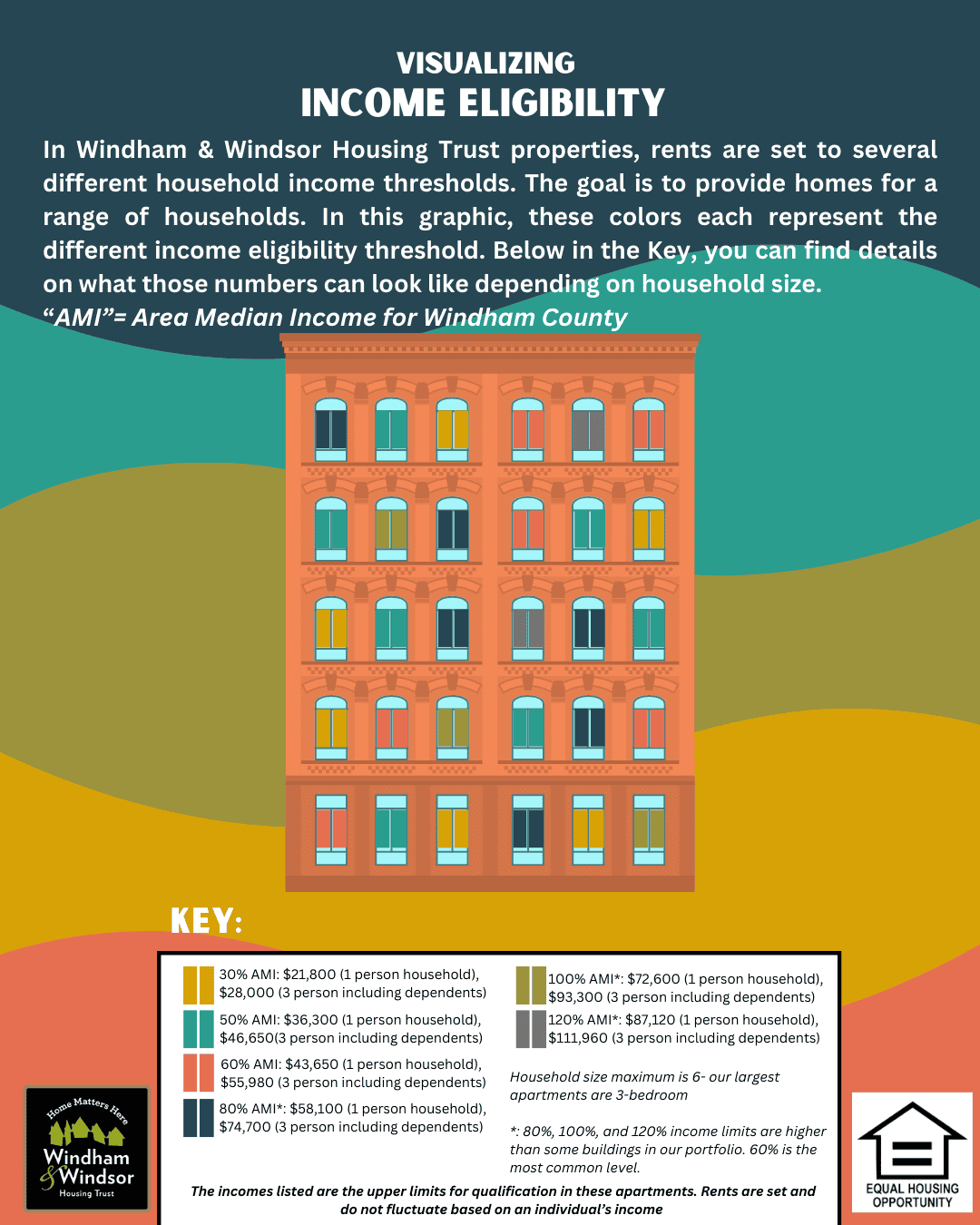
It’s impossible to predict! We do not have waitlists of pre-approved people to move in. We do have income guidelines which will ensure the affordable homes will go to folks with a range of household incomes including workforce, moderate, and low. Below is a helpful graphic which will give you an idea of how there are multiple different eligibilities within a building and generally what those household incomes look like.
When the application process begins (about 2 months before construction is complete) we’ll advertise directly in Brattleboro through paper advertisements and online annoucements. This is where you can help: Please share within your networks!
Eligibility is based on income we also do background checks and require references.
If I apply to live here, will I need to keep my income at the same level to maintain housing in the future? No.
No. Income eligibility is relevant at the time of lease up. You do not have to suppress your income or keep your savings under an amount to stay in housing. If your life situation changes and your income increases, that’s great news. If you are looking to someday think about homeownership, we offer the Homebuyer Education Workshop and subsequent counseling with the fee waived for current residents. This program is HUD certified and meets requirements for most downpayment assistance programs.
How is community safety addressed?
The interior redevelopment work will bring all building systems up to modern safety standards. As with all our redevelopment work, our disigns include planning for: pedestrian and vehicular safety, accommodating easy access by emergency vehicles, safe lighting (dark-skies compliant), and secure building access.
Community safety has been a large conversation at the town level and within our organization. Where traffic safety and design of buildings are incorporated into physical plans, we wanted to put our broader work into this context. Where Brattleboro continues to be a vibrant and beautiful town with many strengths, the town faces some real challenges that have impacted us as well. We do not take these challenges lightly and have intentionally strengthened our focus on safety because of the shift we’ve seen across town. We feel it’s important to share specifics on our current and evolving approach with you here.
1) Connecting residents with resources: For our general rentals, we have free and voluntary access to SASH and the SASH For All programs. These include a SASH coordinator, a Wellness Nurse (RN), and a Mental Health Clinician. These teams work both on the individual/family level on health and wellness goals while also creating community connection among neighborhoods. 2) Proactive Screening: Our leasing protocols include a criminal background check and references. In cases where applicants are supported by case managers for support, we work closely with this entity to determine whether the applicant can be supported to find stability. 3) Accountability: Firm and clear boundaries are put in place when leasing. Residents are walked through the lease agreement and understand the consequences for infractions and lease breaks. Illegal and dangerous activity is followed up with a lease termination. Buildings and apartments are routinely inspected for safety and compliance with lease. 4) Safety in neighborhoods and coordinating with town resources: We regularly meet with the Brattleboro Police Department and coordinate on challenges. We have been hosting community meetings called Restorative Circles at the neighborhood level facilitated by Interaction where residents can voice concerns directly with eachother and with us and build and/or repair community connections.
As A Non-Profit Organization, Does WWHT Pay Property Taxes? Yes
Yes.
Where does funding come from and why does it cost so much to build housing?
You may be surprised to learn that as much as 60% of the funds for a WWHT project comes from investors (such as local banks) rather than from state or federal governments. These investors receive a tax credit in exchange for the funding they provide. This is referred to as a Public-Private Partnership. To capture these funds, an organization must be a competative applicant with a proven track record of success of implementing funders priorities (ex: supporting vitality of downtowns, historic preservation, economic development).
The remaining 40% of funding is awarded to projects which meet stringent development guidelines for housing quality and safety (see list of funding sources below). Development guidelines include environmental restoration, historic standards, Federal energy efficiency standards, Americans with Disabilities Act requirements, and other state and federal mandates. These mandates are good public policy, improve quality of life, and they do add cost.
A significant factor in the overall cost of developing affordable housing has been the escalation of construction costs in recent years. Because the cost of construction is such a large portion of the total housing development budget for WWHT projects, when construction costs go up so do project budgets.
Funding sources can include:
Vermont Housing Finance Agency, Vermont Housing and Conservation Board, HUD HOME, Solar Tax Credit, Efficiency Vermont
Does Affordable Housing Development Lower Nearby Property Values? No
This question comes up nationally so a national independent publication, Shelterforce, investigated. They found that the answer was conclusive: the development of affordable housing is neutral or postive to property values. Find more here.
Housing Words - Getting to the bottom of terminology.
Affordable housing, low income housing, workforce housing, housing, homes, public housing, subsidized housing, market rate housing, missing middle housing.
We approach the housing converation from this perspective: Offering the whole range of housing solutions empowers community members to find the fit that works for them and their families.
Having a home is a basic need- without access to stable housing, so much uncertainty follows. People use the terms listed above to talk about housing and meeting the community’s range of needs but they’re often undefined and used randomly, inadvertently causing confusion. Technically, affordable housing means a person spends no more than 30% of their income towards housing costs. Our mission is to provide this through housing opportunities and programs across a range of income levels. All these other terms are geared towards a general idea of income ranges or how that housing is funded and/or managed. At this point in time, housing that’s avialable at “market rate” (driven by the market prices) isn’t actually affordable (as defined above) to the people who live here.
How Can I Support this Project and Other Housing Projects? Be a Yeighbor!
Thank you for getting involved! There are several ways you can lend your support.
1) Attend local board meetings and hearings
2) Write a letter to the editor discussing why you’re excited about the project
3) Give a donation to support this development. Contact Marion to be part of this fundraising effort: mmajor@homemattershere.org
4) Confront misinformation or harmful stereotypes online and in conversation